
Understanding and Responding to Teasing: A Guide for Neurodivergent Individuals and Families

Teasing is a complex social behavior that ranges from playful bonding to hurtful targeting. For neurodivergent individuals, understanding when teasing is friendly versus harmful—and how to respond appropriately—can be particularly challenging. The social subtleties involved often require interpretation skills that don't always come naturally, making it crucial for families to address this topic with clear guidance and practical strategies.
Learning to navigate teasing situations successfully protects self-esteem and builds confidence in handling social interactions. By understanding different types of teasing and developing appropriate responses, neurodivergent individuals can better advocate for themselves while maintaining positive relationships.
Understanding the Teasing Spectrum
Teasing exists on a spectrum from friendly to harmful, and recognizing where interactions fall on this spectrum is crucial for determining appropriate responses.
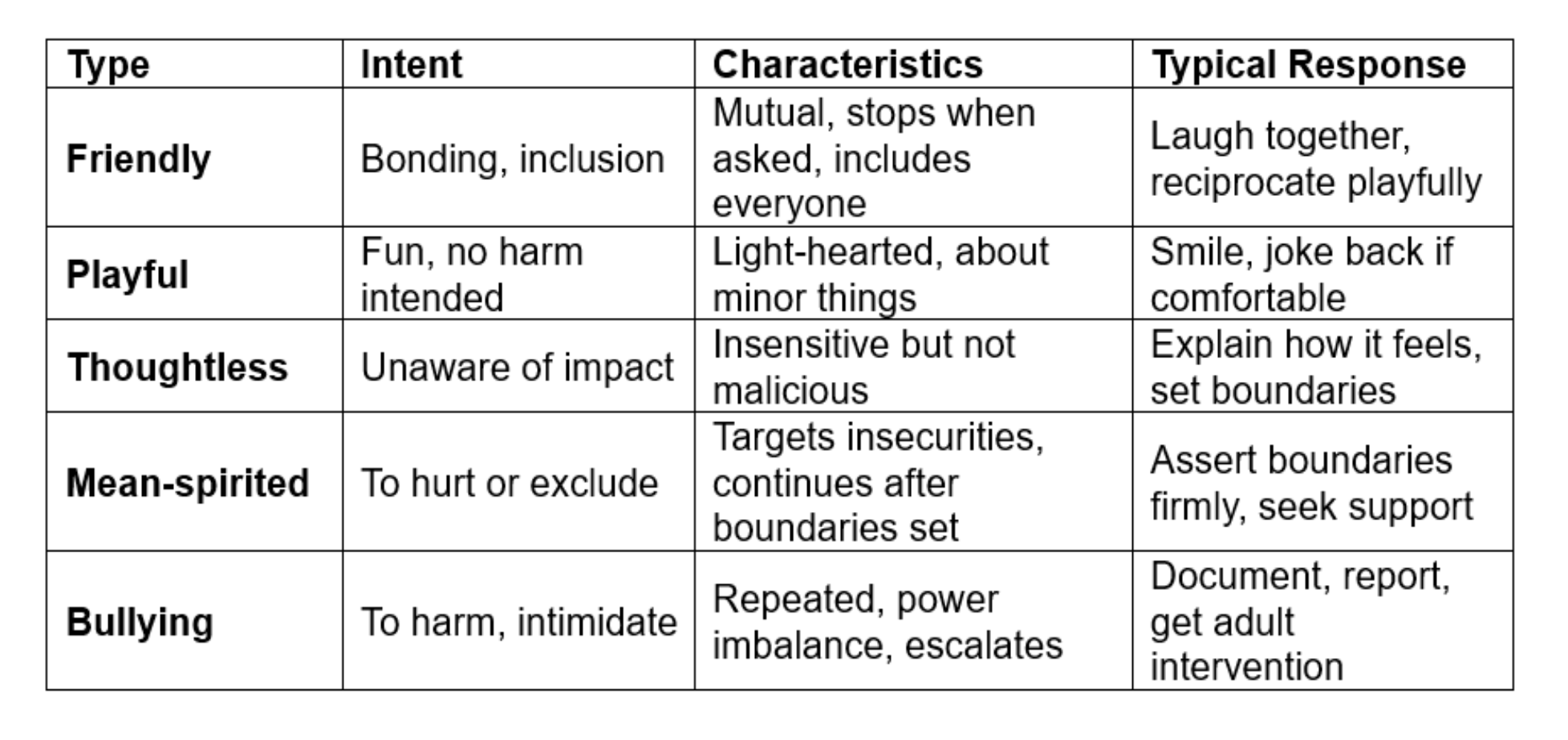
The key distinction often lies in the intent behind the teasing and whether it stops when the target expresses discomfort.
Why Teasing Can Be Challenging for Neurodivergent Individuals
Neurodivergent individuals may face unique obstacles when dealing with teasing.
Interpreting intent can be difficult when social cues are subtle—a smile accompanying a potentially hurtful comment might confuse someone who struggles to read facial expressions in context. Understanding sarcasm and humor requires sophisticated language processing skills that don't always come naturally.
Heightened sensitivity to criticism or social rejection can make even mild teasing feel overwhelming. Many neurodivergent individuals have experienced repeated targeting due to their differences, making them more sensitive to potential teasing situations. The strong desire for social acceptance can sometimes lead to accepting inappropriate teasing or difficulty advocating for respectful treatment.
How Neurodivergent Individuals Can Respond to Teasing
Recognizing Teasing
The first step in handling teasing effectively is recognizing when it's happening. Pay attention to comments that repeatedly focus on the same aspect of your appearance, behavior, or interests, especially when accompanied by smirking, eye-rolling, or looks exchanged with others.
Context matters enormously. The same comment from a close friend who knows your boundaries might be genuinely funny, while identical words from someone you barely know could feel inappropriate. Consider your relationship with the person, the setting, and whether this type of interaction is normal for your relationship.
Developing Response Strategies
Having flexible responses reduces the pressure of needing to think quickly in social situations. For genuinely friendly teasing, you might laugh along if you find it funny or smile and redirect the conversation. When you're unsure about intent, phrases like "What do you mean by that?" give you space to understand the interaction better.
For inappropriate teasing, directness often works best. Saying "I don't find that funny" or "I'd prefer if you didn't comment on that" sets clear boundaries. If someone continues after you've expressed discomfort, that's valuable information about their respect for your boundaries.
Building Self-Advocacy Skills
Start by getting clear about your own boundaries—what kinds of comments feel okay to you, and which cross lines you're not comfortable with. Practice using "I" statements like "I feel uncomfortable when you comment on my clothes" rather than "You always make fun of what I wear."
Remember that advocating for respectful treatment isn't being difficult or overly sensitive—it's taking care of your emotional well-being and teaching others how to interact with you appropriately.
Strategies for Parents and Caregivers
Creating Safe Communication
Establish environments where your child feels comfortable sharing social experiences. Move beyond general questions like "How was your day?" to specific inquiries: "What happened at lunch today?" or "Did anyone say anything that surprised you?"
When your child shares experiences, resist the immediate urge to fix or minimize. Validate that situations felt significant to them, even if they seem minor to you. Creating psychological safety means responding with curiosity rather than judgment.
Teaching Recognition Skills
Unlike neurotypical children who often pick up social nuances through observation, neurodivergent children typically benefit from direct instruction. Use teachable moments when watching movies or TV shows together—pause during social interactions and discuss what you're observing.
Role-playing different scenarios at home allows practice when your child is calm and thinking clearly. Make these sessions feel playful rather than like homework. The goal is building confidence, not perfect performance.
Developing Response Plans Together
Involve your child in developing approaches that feel authentic to their communication style. Work together to identify phrases that feel natural when your child says them. Practice these responses until they feel automatic, and discuss body language—standing tall, making appropriate eye contact, and speaking clearly when setting boundaries.
When Teasing Becomes Bullying
The line between teasing and bullying becomes clear through certain patterns. Frequency and persistence indicate problems—when teasing becomes regular and doesn't stop despite requests to end it. Power imbalances make situations more harmful, whether through physical strength, social status, or institutional authority.
When teasing escalates to bullying, document incidents with details about what happened, when, and who was involved. Report to appropriate authorities and develop safety plans that might include changes to routines or environments while the situation is being addressed.
Digital Age Teasing: New Challenges and Responses
Online environments have fundamentally changed how teasing occurs and spreads, creating both new vulnerabilities and new tools for managing difficult interactions. For neurodivergent individuals who may already struggle with interpreting social cues, digital communication removes important context like tone of voice and facial expressions, making it even harder to determine intent.
Understanding Online Teasing Dynamics
Social media platforms can turn a single teasing comment into a public spectacle. What might have been a brief hallway interaction can now follow someone home, continue overnight, and involve many more participants through likes, shares, or additional comments. The permanence of digital communication adds weight that doesn't exist in face-to-face interactions—screenshots can be shared and hurtful content can be revisited repeatedly.
Gaming environments present particular challenges because competitive "trash talk" is often considered normal culture. This makes it harder to identify when comments cross from acceptable competitive banter into personal attacks targeting neurodivergent characteristics. For someone who takes language literally or struggles with social context, distinguishing between game-related competitiveness and personal harassment can be especially difficult.
Practical Digital Response Strategies
Take time to your advantage. Unlike face-to-face teasing where immediate responses feel expected, digital platforms allow for thoughtful consideration. You can step away, process what happened, and decide whether to respond, how to respond, or whether to involve adults or platform authorities instead.
Document before you react. Taking screenshots of problematic interactions creates records that can be useful if situations escalate. Do this before responding or blocking, as the evidence may disappear once you take action.
Use platform tools effectively. Most social media and gaming platforms have reporting mechanisms for harassment, though these vary in effectiveness. Learning how these work on platforms you use regularly gives you options when situations arise. Privacy settings become tools for managing social interactions—understanding how to control who can contact you or see your content helps create safer digital spaces.
Know when to disengage. Sometimes the best response to online teasing is no response at all. Blocking, muting, or simply not engaging can be more effective than trying to argue or explain why comments are hurtful, especially when dealing with people who seem intent on causing problems.
Helping Neurodivergent Kids Build Social Confidence and Resilience
Focus on developing genuine friendships with people who appreciate you for who you are rather than trying to fit in everywhere. Seek out accepting communities where differences are valued and teasing is not tolerated.
Help neurodivergent individuals frame their differences as interesting characteristics rather than deficits to be hidden. Build skills gradually, starting with low-risk social situations and building confidence before tackling more challenging interactions.
Understanding teasing as a spectrum from friendly to harmful helps individuals make appropriate decisions about responses. Not all teasing requires the same reaction, and learning to distinguish between different types is a valuable life skill.
Building social confidence is gradual. Each successful interaction builds skills and self-assurance for future situations. With appropriate support, clear strategies, and ongoing practice, neurodivergent individuals can learn to handle teasing in ways that protect their well-being while maintaining positive social connections.
The goal isn't to eliminate all teasing from social interactions—friendly teasing can be a normal part of relationships—but to ensure that individuals have the tools they need to recognize when boundaries are crossed and to advocate for respectful treatment.
May 13, 2026Hye Ryeon Lee, PhDHye Ryeon is a neuroscientist with over 10 years of experience studying Autism Spectrum Disorder, including at the Stanford University School of Medicine. She has published numerous papers on the mechanisms of autism in journals such as Nature, Science, and Nature Neuroscience.https://www.linkedin.com/in/hyeryeonlee/